How Artificial Intelligence Will Reshape the Diagnosis of Parkinson’s Disease
Can we see the disease earlier, understand it more deeply and treat it more personally.

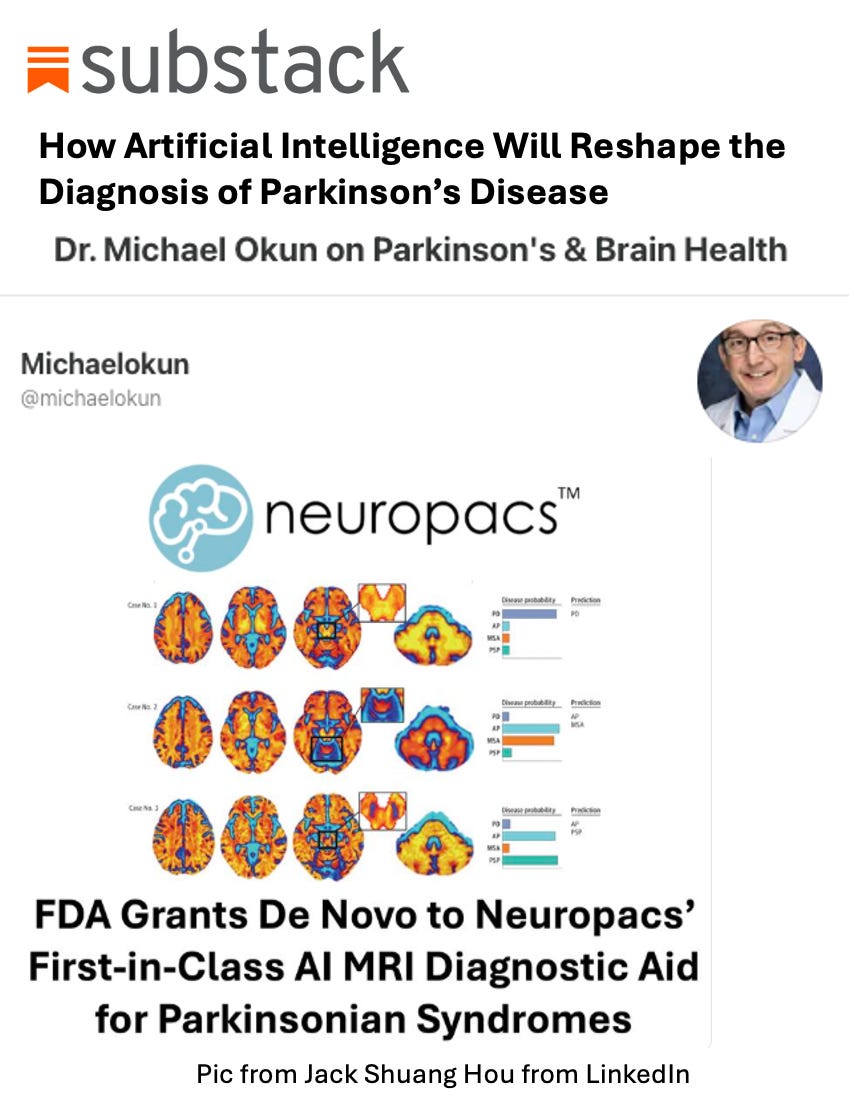
Artificial intelligence has arrived in Parkinson’s disease diagnosis, and many physicians and persons with Parkinson’s are asking the same questions. Can a computer really recognize Parkinson’s disease better than a neurologist? Will AI replace doctors? Can we trust algorithms trained on thousands of MRI scans and wearable sensor recordings? What happens when the AI gets it wrong? These are not science fiction questions anymore. They are unfolding now in clinics and research centers across the world. The excitement is real, however so is the controversy. Parkinson’s disease remains a clinical diagnosis, and no computer currently replaces the expertise of a skilled movement disorders neurologist. Yet for the first time in history, AI tools are beginning to detect patterns invisible to the human eye, and they may fundamentally reshape how we diagnose and understand Parkinson’s disease in the coming decade.
One of the biggest recent advances came through a technology called AIDP, which stands for Automated Imaging Differentiation for Parkinsonism. In 2025, the U.S. Food and Drug Administration granted clearance for clinical use of this MRI-based AI system designed to help distinguish Parkinson’s disease (PD) from multiple system atrophy (MSA) and progressive supranuclear palsy (PSP). This matters because these disorders often look very similar early in the disease course, and even experienced specialists can struggle to tell them apart. AIDP works by analyzing a routine 3-Tesla MRI scan using advanced diffusion imaging and machine learning algorithms called support vector machines. Instead of simply looking at brain pictures the way humans do, the AI measures microscopic patterns of degeneration and “free water” changes across multiple brain regions. In a large NIH funded multicenter study across 21 Parkinson Study Group sites, the system achieved remarkable accuracy in differentiating PD, PSP and MSA, and in a subset of patients its predictions matched autopsy findings in over 93% of cases. For patients and families, this is potentially transformative because it means a standard MRI scan may now provide diagnostic information that previously required years of clinical observation.
After diagnosis, AI is also helping researchers understand a critical truth: Parkinson’s disease is not one disease. Increasingly, scientists believe Parkinson’s represents many biologically different conditions that happen to share overlapping symptoms. A recent study led by Chang Su, Fei Wang and colleagues used machine learning and deep learning to analyze years of clinical progression data, imaging, spinal fluid biomarkers, genetics and transcriptomics. The team identified three major Parkinson’s progression “PACE” subtypes: an Inching Pace form with slow progression, a Moderate Pace form and a Rapid Pace subtype associated with inflammation, oxidative stress and faster decline. This work is important because predicting progression in Parkinson’s has remained elusive for decades. Some people live relatively stable lives for many years, while others decline quickly. AI may help us understand why. One day, instead of telling people “you have Parkinson’s disease,” we may tell them what biological subtype they have and which therapies are most likely to help them.
The next frontier may sit right on your wrist or in your pocket. Wearable devices and smartphones are rapidly becoming digital neurologists. Modern smartwatches and sensors can continuously measure tremor, walking speed, balance, voice patterns and movement complexity. Several recent AI studies using wearable sensors have shown impressive accuracy in detecting Parkinson’s disease from gait and movement patterns alone. Some systems use tiny shoe sensors to analyze gait cycles, while others use accelerometers and gyroscopes built into consumer smartwatches. These technologies are exciting because Parkinson’s symptoms fluctuate throughout the day, and brief office visits may miss important information. In the future, your smartphone may quietly notice that your typing speed slowed, your voice softened or your walking pattern subtly changed years before a diagnosis is made. We are entering an era where continuous digital monitoring may detect disease long before visible disability emerges.
AI may eventually move even further upstream into primary care. Imagine a future where your online medical record itself becomes part of the diagnostic process. Artificial intelligence systems are already being trained to detect subtle combinations of symptoms and health patterns buried in electronic health records. A patient who repeatedly reports constipation, sleep disturbance, anxiety, loss of smell and subtle gait complaints over several years may unknowingly leave behind a digital signature suggestive of Parkinson’s disease. AI systems may eventually alert general practitioners that a patient warrants neurological evaluation. Combined with imaging, biomarkers and wearable data, this approach could allow earlier recognition of disease, potentially years before traditional diagnosis occurs.
Still, caution is essential. AI is powerful, however it is not magic. Algorithms can be biased. Datasets may not represent all patients equally. Many studies showing extraordinary accuracy are performed in highly specialized academic centers and may not immediately translate into every community hospital. Patients should understand that AI tools are assistants, not replacements for physicians. The best future is likely one where experienced clinicians and intelligent systems work together.
Parkinson’s disease diagnosis is entering a new era. MRI scans interpreted by AI, digital biomarkers from wearable sensors, biological subtypes identified through machine learning and electronic health record pattern recognition are converging into a new form of precision neurology. For decades, we diagnosed Parkinson’s disease largely by observing symptoms after substantial brain degeneration had already occurred. AI offers the possibility of seeing the disease earlier, understanding it more deeply and ultimately treating it more personally. The challenge now is ensuring that these technologies remain accurate, ethical, accessible and centered around the most important person in the equation: the person with the disease.
Selected References:
1- Su C, Hou Y, Xu J, et al. Identification of Parkinson’s disease PACE subtypes and repurposing treatments through integrative analyses of multimodal data. npj Digit Med 2024; 7: 184. doi:10.1038/s41746-024-01175-9.
2- Vaillancourt DE, Barmpoutis A, Wu SS, et al. Automated imaging differentiation for parkinsonism. JAMA Neurol 2025; 82: 495–505. doi:10.1001/jamaneurol.2025.0112.
3- Zhi T, Liu H, Wang X, Ibrahim UM, Meng C. MultimodalCNN-PD: a Parkinson’s disease diagnostics framework using multimodal convolutional neural network. Front Aging Neurosci 2026; 18: 1733075. doi:10.3389/fnagi.2026.1733075.
4- Taşyürek EY, Altun ŞM, Uncu AE, et al. A novel multimodal AI framework for early diagnosis of idiopathic Parkinson’s disease. Med Biol Eng Comput 2026; 64: 1689–1711. doi:10.1007/s11517-026-03547-7.
5- Yaghoubi Z, Setayeshi S, Motamed S, Sabeti M. Early diagnosis of Parkinson’s disease through Lite HGWA-Net model: a hybrid CNN based on wavelet transform and attention mechanism. Diagnostics (Basel) 2026; 16: 550. doi:10.3390/diagnostics16040550.
6- Li Y-Z, Wang Y, Cai C, et al. Habitat-based MRI radiomics for enhanced Parkinson’s diagnosis. Sci Rep 2026; 16: 4755. doi:10.1038/s41598-026-37923-y.
7- Rashnu A, Salimi-Badr A. Integrative deep learning framework for Parkinson’s disease early detection using gait cycle data measured by wearable sensors: a CNN-GRU-GNN approach. 2024. arXiv:2404.15335.
8- Li M, Kristjánsdóttir I, van Eimeren T, et al. A hybrid CNN and ML framework for multi-modal classification of movement disorders using MRI and brain structural features. 2026. arXiv:2602.05574.
9- Matsumoto M, Miah ASM, Asai N, Shin J. Machine learning-based differential diagnosis of Parkinson’s disease using kinematic feature extraction and selection. 2025. arXiv:2501.02014.
10- Xiang J-Z, Wang Q-Y, Fang Z-B, et al. Advancing Parkinson’s disease detection through multi-dimensional machine learning: a comprehensive framework using wearable movement sensor analytics. Front Physiol 2026; 16: 1737585. doi:10.3389/fphys.2025.1737585.
11- Machado Reyes D, Yan P. SPARROW: Subtyping Parkinson’s disease with agentic reasoning and robust omics workflow. npj Artif Intell 2026; published online April 16
This might clear up some of the overall confusion. There are so many different ways PD affects people across the board. This might also help family members understand why their loved one doesn't display symptoms they might expect. Thank you for keeping us informed. I look forward to seeing how this will change the way people are diagnosed and treated in the future.
Is this available now?